
By Marios — founder of pcprice.watch, tracking PC hardware prices across eBay and 6 other marketplaces
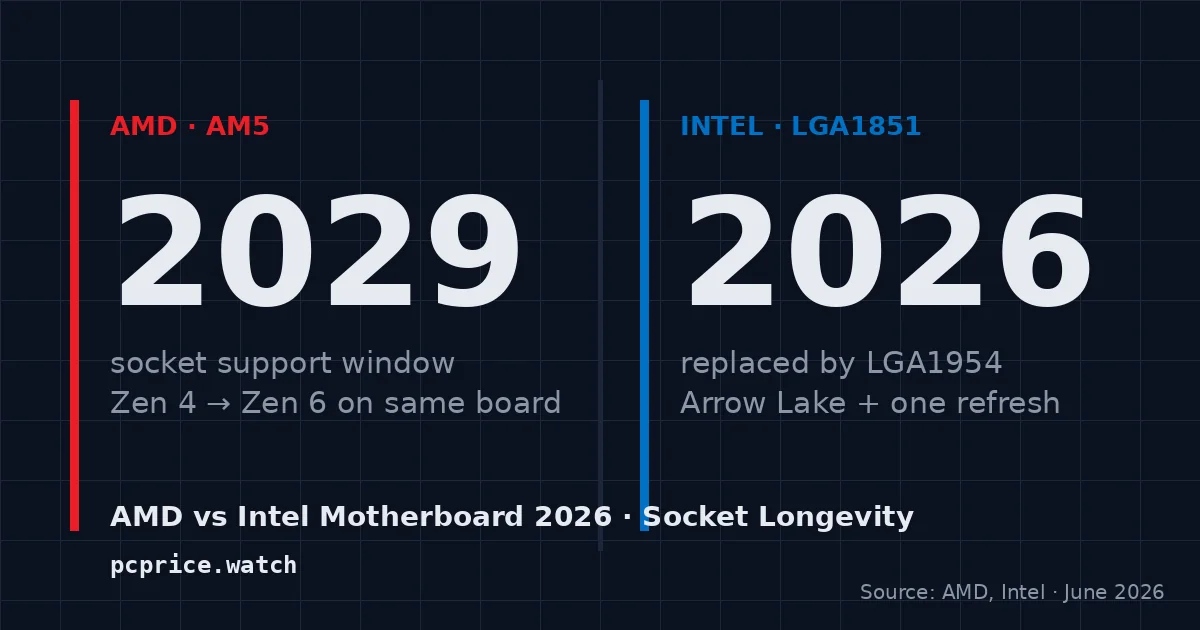
The AMD-or-Intel motherboard decision in 2026 is mostly settled before you compare a single spec sheet. AMD has committed to AM5 through 2029. Intel’s LGA1851 socket is already on its way out, replaced by a new LGA1954 socket for Nova Lake in late 2026. That single fact changes the math on every other comparison below.
This guide goes head-to-head on the things that actually decide the platform: socket lifespan, real gaming performance, power draw, total build cost, and what to do if you’re buying used. Pricing is current to June 2026.
Key Takeaways
- AMD AM5 is officially supported through 2029 (Tom’s Hardware, 2025). Intel LGA1851 will host Arrow Lake and one refresh, then be replaced by LGA1954
- Gaming: Ryzen 7 9800X3D beats Core Ultra 7 265K by roughly 22% at 1080p (Tech4Gamers, 2025)
- Productivity / efficiency: Arrow Lake (Core Ultra) uses about 41% less Cinebench MT power than the 14700K it replaced (Tech4Gamers, 2025)
- Mid-range boards are priced close: MSI B850 around $230, MSI B860 around $227 in June 2026
- Used LGA1700 buyers should verify the 0x12B microcode patch before purchase (Intel, 2024)
- Steam Hardware Survey shows AMD desktop share at 44.97% in May 2026, up 1.7 percentage points in five months (Tom’s Hardware, 2026)
So, AMD or Intel?
For most builders in 2026, AMD AM5 is the safer call. The socket gives you a real upgrade path, the X3D chips dominate gaming, and a B650 or B850 board priced at $150-230 covers anything short of a flagship build. Intel is still a strong pick if you specifically want Arrow Lake’s efficiency for mixed productivity workloads, or if you can find an LGA1700 board paired with a patched 13th/14th gen chip for a real discount on the used market — but go in eyes-open.
That decision rests on five things, in order of impact: platform lifespan, gaming performance, productivity and power efficiency, total system cost, and the used-market angle. The rest of this guide covers each.
Platform Lifespan: AM5 to 2029 vs LGA1851’s One-and-Done
AMD confirmed at Computex 2025 that AM5 will be supported through 2029, per Tom’s Hardware’s coverage of the slide. That’s at least two more CPU generations after Zen 5 (Zen 6 is already confirmed as AM5-compatible). A B650 board you buy today can run a Ryzen 7000, 9000, and a future Zen 6 chip without a motherboard swap.
Intel’s LGA1851 story is the opposite. TechPowerUp reported Intel confirming an Arrow Lake Refresh for 2026 — then Nova Lake on a new LGA1954 socket later that same year. A second source, Tom’s Hardware, corroborates the socket change. In practical terms: an LGA1851 Z890 board purchased in 2026 will get at most one more CPU option (the Refresh) before the platform is dead.
[CHART: Lollipop chart — Socket support window in years. AM5: ~7-year support window (2022–2029+). LGA1851: ~2-year window (2024–2026). LGA1700: ~3-year window (2021–2024). LGA1200: ~2-year window. Source: AMD roadmap, Intel platform announcements, June 2026.]
Socket Lifespan SVG Chart
The pattern is consistent. AMD treats sockets as multi-generation platforms; Intel ships a new one every two years. That doesn’t make Intel wrong — there are real engineering reasons new memory controllers and power delivery sometimes force a socket swap — but it does change what your motherboard is actually worth in 2027.
Gaming Performance: Ryzen X3D Still Wins, Comfortably
The 3D V-Cache chips remain the gaming benchmark to beat. Tech4Gamers’s head-to-head between the Ryzen 7 9800X3D and Core Ultra 7 265K shows the 9800X3D pulling ahead by roughly 22% at 1080p and 19% at 1440p in their test suite. At 4K, the gap narrows because the GPU becomes the bottleneck — but no game flips the result.
Step down to last-gen and AMD still wins, by less. Hardware Times ran a 20-game comparison of the Ryzen 7 7800X3D against the Core i7-14700K and measured the 7800X3D about 8.6% faster on average at 1080p (193 vs 177 FPS), with the lead shrinking to 1-5% at 1440p as the GPU takes over.
What this means in motherboard-decision terms: pairing a B650 or B850 board with a 7800X3D ($324 at its 2026 low per WCCFTech) or 9800X3D ($433-459, per Newegg) is the highest gaming-FPS-per-dollar build in 2026, full stop. Intel has no direct counter at the gaming-FPS layer.
The caveat: if your “gaming” rig actually spends most of its time in productivity apps (compile, render, encode), see the next section. The X3D advantage shrinks or inverts there.
Productivity and Power Efficiency: Where Intel Closed the Gap
Arrow Lake is the most efficient desktop Intel platform in years. Tech4Gamers’s head-to-head measured the Core Ultra 7 265K drawing about 7W at idle versus 24W on the Core i7-14700K — a 70% drop generation-on-generation. Under Cinebench multi-thread, the 265K used roughly 41% less package power than the 14700K it replaces. Under Prime95 AVX, the 265K still pulled around 310W to the 14700K’s 357W.
That changes the value proposition. If you’re a content creator running long renders or compiles, Arrow Lake gives you Intel’s traditional multi-thread strength without the thermal headache that defined Raptor Lake. A Z890 board paired with a Core Ultra 7 265K (~$355 street, per Tech4Gamers) is a credible mixed-workload pick.
The flip side: AMD’s X3D chips were already efficient. The 7800X3D pulls about 43% less power than the 14700K under 1080p gaming per Hardware Times. Arrow Lake didn’t catch the X3D line for gaming — it just stopped losing badly in efficiency to it.
Power Draw SVG Chart
One detail that bites first-time Intel buyers: motherboard BIOS defaults matter. Many Z790 boards shipped pre-2024 with power limits unlocked beyond Intel’s spec, which is part of what triggered the Vmin shift saga (more on that below). Always set “Intel Default Settings” or equivalent in BIOS on a new Intel board before running it under sustained load.
Total Build Cost: Motherboard + CPU + RAM
The motherboard price alone is misleading — the platform decision changes what CPU and RAM you can use. Here’s how a representative mid-range build costs out in June 2026, US street prices.
| Component | AMD AM5 build | Intel LGA1851 build |
|---|---|---|
| Motherboard (mid-range) | MSI MAG B850 Tomahawk WiFi — $230 | MSI MAG B860 Tomahawk WiFi — $227 |
| CPU (mainstream gaming pick) | Ryzen 7 7800X3D — $324 | Core Ultra 7 265K — ~$355 |
| RAM (32GB) | DDR5-6000 CL30 — see note below | DDR5-6400+ CL30 — see note below |
| Platform-mandatory feature | DDR5 only | DDR5 only |
| Upgrade ceiling on same board | Through Zen 6 (2027+) | Arrow Lake Refresh only |
The motherboard prices are nearly identical at the mid-range tier. The differentiator is the CPU + upgrade path. For pure gaming, the 7800X3D outperforms the 265K and costs less. For mixed workloads, the 265K’s productivity advantage closes most of the gap.
RAM market caveat (June 2026): DDR5 spot prices are extremely volatile due to AI-driven DRAM shortages. Resell Calendar reported a 500% spike on certain memory SKUs in late 2025. Get a current quote on a 32GB DDR5-6000 CL30 kit before you finalize either build — the price moves week to week.
Both platforms now require DDR5. The old DDR4-cost-advantage argument for Intel LGA1700 only applies if you’re shopping used — see below.
Buying Used: AM4 vs LGA1700, and the Intel Instability Caveat
The used motherboard market is where AMD vs Intel gets interesting again. AM4 boards (B550, X570) routinely sell for $50-90 on eBay paired with a Ryzen 5000-series CPU. LGA1700 boards (B760, Z790) are similarly cheap because original buyers are moving to LGA1851.
But used LGA1700 carries a specific risk the used AM4 market does not: the 13th/14th gen Intel instability problem.
Intel’s official statement (2024) identified four root causes that degraded K-series Raptor Lake chips over time — culminating in “Vmin shift” damage that microcode patches mitigate but do not reverse. The final fix shipped as microcode 0x12B in September 2024. Intel extended the warranty on affected K-SKUs by two years.
The practical buyer rules for used LGA1700:
- Verify the BIOS is updated to a release with the 0x12B microcode (manufacturers list this in BIOS release notes)
- Ask the seller to run HWiNFO64 or CPU-Z and screenshot Vcore at idle. Persistent voltages above 1.5V on a 13900K / 14900K signal degradation
- Pair preferentially with a non-K chip (13700, 14600 non-K). The instability problem was concentrated on K-series parts running at high boost voltages
- Insist on a return window. eBay’s standard 30-day returns are enough for a quick Cinebench stability check
The used AM4 market is the cleanest budget play. A Ryzen 5 5600X paired with a B550 board on eBay is often under $200 for the combo, performs adequately for 1080p gaming, and has no equivalent platform-wide reliability cloud.
Market Share: AMD Is Still Gaining
The Steam Hardware Survey is the largest public sample of what PC gamers actually use. Per the May 2026 reading, AMD desktop CPU share sits at 44.97% to Intel’s 55.02% — up from 43.34% in January 2026, per Tom’s Hardware’s analysis.
That’s a 1.7-percentage-point gain in five months. The trend matters for motherboard buyers in two ways. First, the AMD aftermarket (B650/B850 boards, AM5 CPU coolers, BIOS updates) is bigger and growing — easier to find tested combinations and community fixes. Second, AMD pricing pressure on Intel keeps the X870 / Z890 boards competitive instead of drifting upward.
When you cross-reference the Steam survey with eBay sold-listings volume, the same pattern holds: AM5 motherboard listings have been growing faster than LGA1851 listings month over month since Arrow Lake’s launch in late 2024. Sellers respond to where the buyers are.
Common Mistakes Choosing Between AMD and Intel
Buying an LGA1851 board expecting it to take Nova Lake. It will not. Nova Lake uses LGA1954, per both Tom’s Hardware and TechPowerUp. If you want a one-and-done Intel build, go in knowing the platform’s upgrade ceiling.
Assuming X3D is always the right gaming pick. It usually is — but if you’re CPU-bottlenecked in a productivity tool (DaVinci Resolve, Blender, code compile), the higher-thread Core Ultra 9 285K or Ryzen 9 9950X may serve you better than a gaming-focused X3D chip. Match the chip to the workload, not the marketing.
Paying X-series board prices for non-X CPU plans. A $300+ X870 board paired with a Ryzen 5 7600 is overspending. B650 or B850 covers everything the non-X chips can use. Same on Intel: Z890 is wasted on a non-K Core Ultra 5.
Ignoring the BIOS Flashback feature on AM5. A 2022-stock B650 board pulled from a warehouse may need a BIOS update to boot a 2024 Zen 5 chip. BIOS Flashback lets you flash without a CPU installed. Check the spec sheet before you click buy on a budget AM5 board.
Buying any 13th/14th gen K chip used without verifying the Vmin patch. This is the single biggest used-Intel trap right now. Microcode 0x12B prevents new damage; it does not undo damage already done.
FAQ: AMD vs Intel Motherboards
Which is faster overall, AMD or Intel in 2026?
It depends on workload. For gaming, AMD’s Ryzen 7 9800X3D leads the Core Ultra 7 265K by about 22% at 1080p in Tech4Gamers’s test suite. For multi-threaded productivity (rendering, encoding), Intel’s Arrow Lake closes most of the gap and the Core Ultra 9 285K trades blows with the Ryzen 9 9950X. There is no single “faster” answer — match the chip to your workload.
Is the AM5 socket really supported until 2029?
Yes. AMD confirmed at Computex 2025 that AM5 will receive at least two more CPU generations after Zen 5, taking the platform through 2029, per Tom’s Hardware. Zen 6 is already confirmed AM5-compatible. AMD has a track record here — AM4 ran from 2017 to 2024.
What’s the cheapest AMD AM5 motherboard worth buying in 2026?
An A620 or low-tier B650 board in the $130-160 range is the floor for a real build. Look for BIOS Flashback (lets you update firmware without a CPU), at least one PCIe 4.0 NVMe slot, and DDR5-5600 or faster memory support. Below $130 you start losing USB ports and VRM quality enough to limit CPU choice.
Should I wait for Nova Lake before buying an Intel motherboard?
If you’re buying Intel and you can wait until late 2026, yes. Nova Lake on LGA1954 will be the new Intel platform with its own upgrade window. Buying LGA1851 in mid-2026 commits you to a socket with at most one more CPU release. Either wait or commit to a build you won’t want to upgrade.
Is a used Z790 board safe in 2026?
Safe if you pair it with a non-K 13th/14th gen CPU or a CPU whose seller can prove healthy voltages, and the board’s BIOS is updated to a release containing microcode 0x12B. The risk is concentrated on K-series chips that ran at high boost voltages for long periods. A 13700 (non-K) on a Z790 with the patched BIOS is a much safer used build than a 14900K on the same board.
Does AMD or Intel have better motherboard build quality in 2026?
It’s a wash at the same price tier. Same OEMs (ASUS, MSI, Gigabyte, ASRock) build both AMD and Intel boards, often using shared VRM components across SKUs. Pick by the specific board’s review, not by chipset brand. GamersNexus and Hardware Unboxed VRM thermal tests are the best signal.
Ready to price your build? Compare current motherboard prices on eBay across 7 markets and set a price alert when a specific board or CPU drops below your target.
Sources:
- AMD AM5 support through 2029 — Tom’s Hardware — Coverage of AMD’s Computex 2025 platform roadmap
- Intel Arrow Lake Refresh and Nova Lake 2026 — TechPowerUp — Intel confirmation of 2026 desktop CPU cadence
- Nova Lake LGA1954 socket — Tom’s Hardware — Confirmation of LGA1851’s successor
- 9800X3D vs Core Ultra 7 265K — Tech4Gamers — Gaming and pricing head-to-head
- Core Ultra 7 265K vs Core i7-14700K — Tech4Gamers — Arrow Lake power efficiency vs Raptor Lake Refresh
- 7800X3D vs i7-14700K, 20-game test — Hardware Times — Sustained gaming benchmark and power data
- Intel 13th/14th gen instability root cause — Intel Community (official) — Vmin shift, microcode 0x12B, warranty extension
- Steam Hardware Survey AMD share — Tom’s Hardware — May 2026 desktop CPU market share analysis
- Best Motherboards 2025-2026 — Tom’s Hardware — Current chipset pricing across AMD and Intel platforms
- X870/X870E launch pricing — TechPowerUp — X870 series MSRP and street prices
- Ryzen 7 7800X3D 2026 low — WCCFTech — Reference for $324 floor
- DDR5/DDR4 RAM price crisis — Resell Calendar — Context for June 2026 memory pricing volatility