

By Marios — founder of pcprice.watch, tracking hardware prices across 7 global marketplaces
Key Takeaways
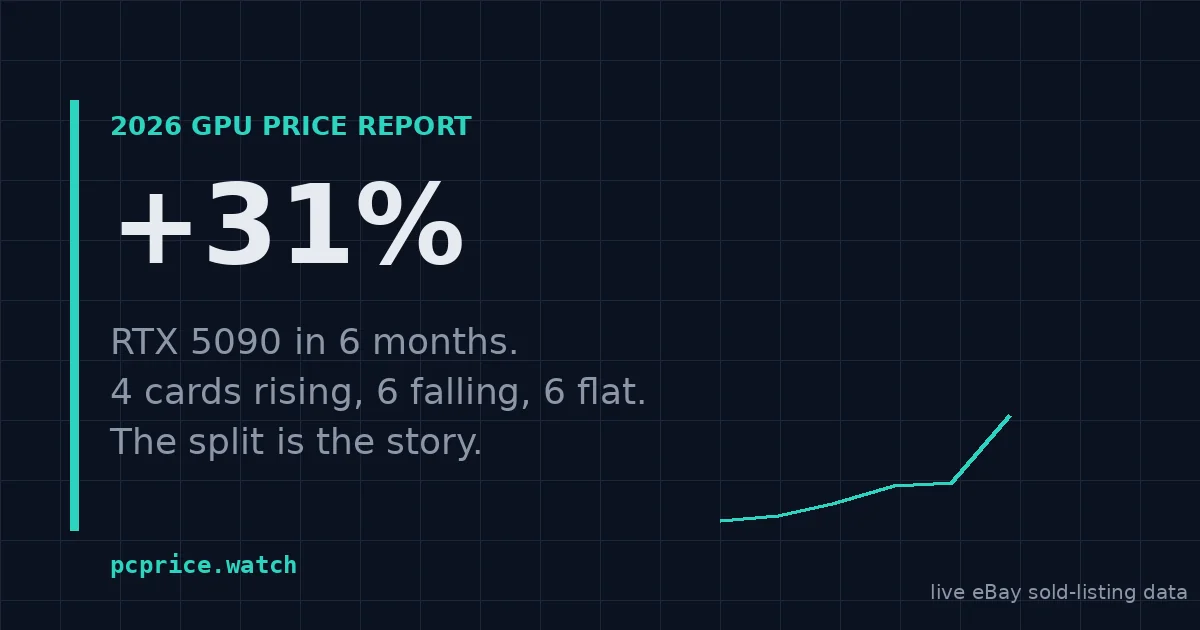
- The “are GPU prices going up?” question has no single answer in 2026. Of 16 cards tracked, 4 rose >5%, 6 fell >5%, 6 stayed flat. The split, not the average, is the story.
- Every rising card has 16GB+ of VRAM. RTX 5090 +31%, RTX 3090 +48%, RTX 5080 +22%, RTX 4090 +13%. Every flat or falling card sits at 8-12GB. Home AI inference is now a real GPU buyer category.
- The RTX 3090 is the chart’s biggest surprise. A 5-year-old card rose from a $639 median in January to $946 in June — the largest 6-month gain in our entire tracked catalogue. Its $/GB-VRAM ratio is the lowest on the market.
- Last-gen midrange is finally cheap. RTX 3070 and 3080 are down ~20% in 6 months. These are the 1440p-build bargains of mid-2026, if you don’t need raytracing or local AI.
Are GPU prices going up in 2026?
The honest answer is that the question is too coarse. Of the 16 GPUs we track every day across seven national eBay markets, only 4 cards rose more than 5% in the last six months. Six cards fell more than 5%. Six stayed essentially flat. That isn’t “GPU prices going up.” That’s a split market — and the split runs along a line nobody was watching for.
The 6-month median price change, top to bottom:
Look at that distribution and the easy headline collapses. “Are GPU prices going up?” is the wrong question. The right one is: which GPU prices are going up, and why? Because every single card that gained more than 5% has one thing in common, and every card that lost or flatlined shares the opposite trait.
Across 16 GPUs tracked daily on eBay between January and June 2026, 4 cards rose more than 5%, 6 fell more than 5%, and 6 stayed flat. Average price change across the basket: −1.4%. Looking at the average misses the fact that four cards are silently dragging the high end of the market upward while the midrange does the opposite (pcprice.watch, 2026).
For the deeper “which card to actually buy right now” view, our GPU buying guide breaks down each model with its current cross-market median and benchmark scores. This pillar zooms out to the trend.
Which graphics cards have actually risen in price?
Four cards. All of them have 16GB of VRAM or more. In order:
The RTX 5090 rose from a $1,641 median in January 2026 to $2,150 in June 2026 — up 31.0%. That puts the used 5090 at 7.6% above its $1,999 MSRP, six months after launch. It is the only card where the secondary market is more expensive than what NVIDIA prices it at.
The RTX 3090, a five-year-old card, rose from $639 to $946 — up 47.9%, the largest gain on our entire chart. Nothing about the card’s gaming relevance explains this. The 3090 was discontinued. New games run better on a $250 RX 7800 XT. But the 3090 has 24GB of VRAM, and 24GB is the cheapest VRAM-per-dollar ratio you can buy in 2026.
The RTX 5080 rose 22.3% to a $1,090 median. The RTX 4090 rose 12.8% to $1,551 — back near its $1,599 MSRP after dipping in March, when buyers briefly shifted attention to the 5090.
That June spike on the 5090 chart isn’t noise. It’s a single-month jump of 18%, the steepest monthly move on any card we track this year. It tracks roughly to the timing of the latest open-weight model releases that finally need more than 16GB to run at usable speeds.
The unifying trait isn’t gaming performance. The RTX 4080 is faster than the 3090 at almost every game, and the 4080 is down 7.4% over the same window. The unifying trait is VRAM capacity. The 3090, 4090, 5080, and 5090 are the only cards in our catalogue with 16GB or more of usable VRAM — and they’re the only cards rising. That’s not a coincidence.
For broader context on used flagship pricing, see our RTX 5000-series used price tracker.
Why are flagship GPUs going up while midrange stays flat?
The short version: local AI inference is a new GPU buyer category that didn’t exist in 2022, and it only wants high-VRAM cards. Every midrange and last-gen midrange card is responding to a normal gaming-demand curve that decays as new releases arrive. The high-VRAM cards are responding to a second demand curve stacked on top of gaming — one driven by people running 70B-parameter language models, Stable Diffusion XL, and image-to-video workflows on a single workstation at home.
The math is brutal. A current 24GB workstation card (RTX 6000 Ada, A5000) costs $4,000+ new. A used RTX 3090 with the same 24GB VRAM costs $946. A used RTX 4090 costs $1,551 with 24GB. The RTX 5090 with 32GB costs $2,150 used. These are the only sub-$2,500 cards that can run a 70B-parameter LLM at usable token-per-second rates without offloading to system RAM. The price ceiling on the home AI segment is the workstation card; the floor is whatever they have to pay for that 3090. So they pay.
The RTX 3090 rose 47.9% in six months despite being a five-year-old discontinued GPU that loses every modern game benchmark to a current $250 card. The single common trait between every rising card (3090, 4090, 5080, 5090) is 16GB+ VRAM. The single common trait between every flat or falling card is sub-16GB VRAM. Local AI inference is now a structural new demand source pulling on the secondary GPU market (pcprice.watch, 2026).
Meanwhile midrange gaming demand has done what midrange gaming demand always does: it’s elastic. When the RTX 5060 launched, the RTX 3060 didn’t disappear — it kept supplying 1080p builds at $186. The 4060 sits at $250. The 5060 sits at $304. Each tier is roughly $50-70 above the previous, and none of them are moving meaningfully because supply is finally adequate at every tier. If you’re building a 1080p or 1440p gaming PC in mid-2026, the prices you see today are roughly the prices you’ll see in three months. That’s normal. It’s the high end that’s broken.
Are new RTX 5060 and 5070 prices coming down?
Not really, and that’s the disappointment if you’ve been waiting. The RTX 5060 has moved from $319 in January to $304 in June — a 4.6% drop. The RTX 5070 has moved from $508 to $514 — essentially flat. Six months into the 50-series generation, both cards still sit close to MSRP: the 5060 trades at 1.8% over its $299 MSRP, the 5070 at 6.3% under its $549 MSRP.
This is not the typical pattern. By six months post-launch, last-gen midrange cards were normally trading 10-15% below MSRP on the secondary market. The RTX 4070, for comparison, sat 28.8% below its MSRP at the same point in its lifecycle. The 5070 sitting at -6% is the unusual data point.
The reason it’s not falling is a quieter version of the flagship story. New 50-series supply still lags demand at every price tier. The RTX 5070 isn’t expensive used because the secondary market is overheated; it’s expensive used because the new market still trades at €824 (around $880) according to the RTX 5000-series tracker. When new is scarce at $880, used at $514 isn’t a bargain — it’s the only available option.
If you’re trying to time a purchase, our seasonal used-GPU buying guide covers the months historically associated with secondary-market softening. Spoiler: the September-October window before next-gen leaks is the most consistent dip across multiple generations.
For deeper RTX 5060 / 5070 / 5080 country-by-country data, the RTX 5000-series pillar has the full breakdown.
Will GPU prices keep rising through the rest of 2026?
The flagship story is structural, so probably yes through the end of 2026. The midrange is going to do what midrange always does, which is drift slowly downward as supply catches up.
The flagship trajectory depends on three variables: (a) whether NVIDIA releases a 5090 Ti or Super refresh — every leak we’ve seen says no until 2027; (b) whether the home-AI workload trend reverses — there’s no public signal that it will; and © whether anyone produces a cheaper 24GB+ alternative — AMD’s W7900 is $3,000+, Intel has nothing in the segment. None of those variables are pointing toward relief. That means the 3090 / 4090 / 5090 trio probably continues drifting upward through the rest of 2026.
The midrange will keep doing what it’s already doing. The RTX 5060 and 5070 are likely to soften 5-10% by autumn as RTX 60-series rumours intensify. The 4060 and 4070 are already comfortably below MSRP and will probably drop another 5%. The biggest opportunity is the RTX 3070 and 3080 — already down 20% in six months and still falling. By Q4 these become the budget 1440p bargains of the year if you don’t care about ray tracing.
The RTX 3090’s data point is the one that should make you pause. It’s the only card on this chart that’s still well below MSRP — yet rising fastest. The market is telling us that even after a 48% surge, the secondary 3090 is still underpriced relative to what 24GB of VRAM is worth in mid-2026. That’s a leading indicator. If we re-run this chart in October, the 3090 may close another $150 of the gap to its $1,499 launch price.
Where to buy at the best price right now
Once you’ve decided what tier you’re shopping for, the cross-market spread matters more than the headline median. eBay markets aren’t fungible. For mainstream cards, the US and UK trade at the lowest medians; for high-VRAM AI-driven cards, the spread compresses because demand is global. Each GPU buying guide page on pcprice.watch shows the 7-market breakdown live.
A quick rule of thumb based on six months of cross-market data:
- Midrange used (RTX 4060/4070, RX 7800 XT, RX 9070 XT): the US is usually 15-25% cheaper than continental Europe. Worth importing if the spread exceeds $80 after shipping.
- Last-gen bargains (RTX 3070, 3080): Eastern European markets (Poland especially) often surface as the cheapest after currency conversion. The UK is generally the cheapest practical option for non-EU shipping.
- Flagships (RTX 4090, 5080, 5090, 3090): the spread collapses to under 10% across markets — global demand pulls every market upward in lockstep. Buy locally; shipping risk and customs are not worth chasing.
If you’re trying to estimate the resale value of an entire system before selling parts, our how much is my PC worth guide walks through the sum-of-parts methodology with current 2026 numbers. If you want to track a specific card before buying, every page on pcprice.watch is a live tracker — the best PC part price tracker comparison covers our methodology against the alternatives.
Frequently asked questions
Are graphics card prices going up in 2026?
Only for cards with 16GB or more of VRAM. The RTX 5090, 5080, 4090, and 3090 are all up between 13% and 48% over the last six months. Cards with 12GB or less are flat or down. The split is the story.
Why are RTX 3090 prices going up in 2026?
The home AI workload market. The RTX 3090 has 24GB of VRAM at $946, while the next-cheapest 24GB option is a $1,551 RTX 4090. Buyers running local LLMs and image-generation pipelines have made the 3090 the cheapest workable card in the segment, pulling its price up against every normal depreciation curve.
Are RTX 5060 and 5070 prices coming down?
Marginally. The RTX 5060 is down 4.6% over six months to a $304 median, the 5070 is essentially flat at $514. Neither has dropped enough to make “wait for a deal” worth it. New 50-series supply still constrains the secondary market.
Which GPU lost the most value in 2026?
A tie between the RTX 3070 and RTX 3080, both down around 20%. The 3070 fell from $239 to $190, the 3080 from $350 to $279. These are now legitimate 1440p bargains if you don’t need ray tracing, DLSS 4, or local AI workloads.
Will GPU prices keep rising through the rest of 2026?
Flagships likely yes — the AI workload demand is structural, not a supply hiccup. Midrange will continue softening modestly through autumn as RTX 60-series rumours build. The biggest dip window historically is September-October before next-gen launches.
What to do with this
The single most useful takeaway is that the question “are GPU prices going up?” has a different answer depending on which generation you care about. If you’re a 1440p gamer shopping for an RTX 3070 or 3080, your prices are dropping — wait two more months if you can. If you’re an AI workload buyer eyeing a 3090 or 4090 for VRAM, your prices are rising — buy now or be priced out by autumn. If you’re shopping for current-gen midrange (5060/5070, RX 9070 XT), it doesn’t matter what month you buy in. Prices aren’t moving.
The home AI workload demand pattern wasn’t on the chart 18 months ago. It is now the most important variable in flagship GPU pricing — more than gaming demand, more than crypto did at its peak, more than miner supply dumps during the 2022 crash. If you’re tracking GPU prices in 2026 and not separating cards by VRAM capacity, you’re looking at the wrong axis.
We re-pull the data every eight hours across seven markets. To watch a specific card’s trajectory, head to its page on the GPU buying guide index — every card has a six-month price history chart that updates as we go.
Sources: pcprice.watch tracker, daily eBay sold-listing prices across 7 national markets (US/UK/DE/ES/FR/IT/AU), extracted from frontend/public/data/*_price_history.json, n > 50,000 listings across 16 GPU models, January 2026 through June 2026. MSRPs sourced from manufacturer launch announcements. Currency normalisation: USD reference, mixed-market median.
Retrieved 2026-06-19.

